WORLD CULTURE REALMS
The world is divided into eight major culture realms based on shared language, religion, traditions, and historical background. Below are the source of the map, the geography it covers, and the characteristics of the eight culture realms.
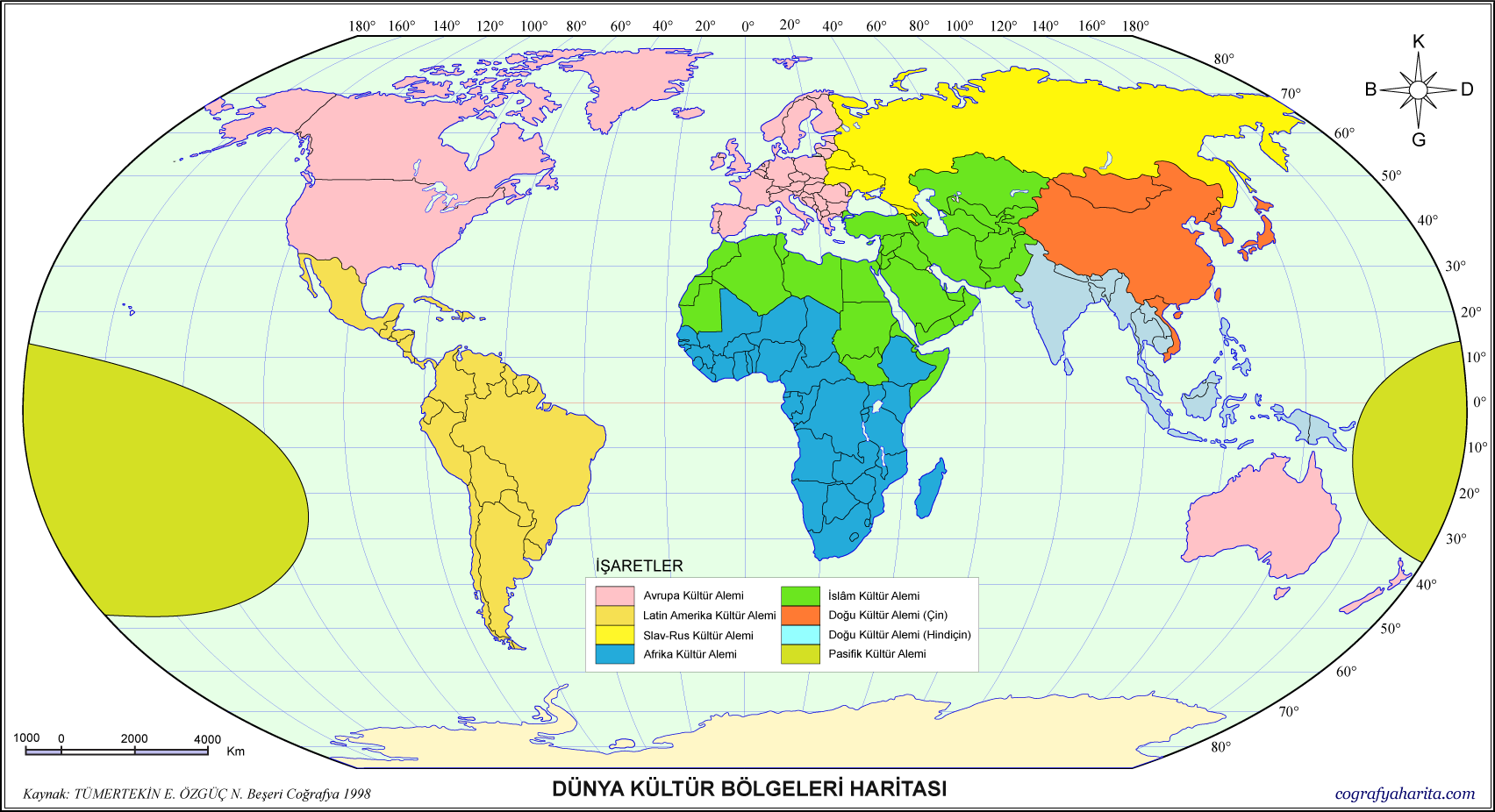
A society's culture is shaped by non-material elements (morality, religion, legal rules) as much as material elements (geographical location, climate). The transition from nomadic to settled life was decisive in the emergence of different cultures across various regions; settled life accelerated socialization and the spread of cultural elements.
In this classification, the world is divided into eight culture realms based on shared language, religion, and traditions rather than political borders: European, Latin American, Slavic-Russian, Islamic, African, two branches of the Eastern culture realm (Chinese and Indochinese), and finally the Pacific culture realm. Each realm is represented by a different color on the map.
The classification is based on the culture regions distinction presented by geographers Erol Tümertekin and Nazmiye Özgüç in their textbook Human Geography (1998).
The colors correspond to the map legend.
Also referred to as "Western Culture," this realm is considered to have the widest spatial spread in the world; extending beyond the European continent, it forms the dominant cultural framework in North America (USA, Canada) as well as Australia and New Zealand. It is divided into three sub-branches: Northern European culture represented by Denmark, Sweden, Norway, Iceland, and Finland; Eastern European culture widespread in countries such as Slovakia, Ukraine, and Bulgaria; and Western European culture led by France, Germany, and Spain.
As another term for South and Central America, this realm encompasses all Central and South American countries extending from Mexico to Argentina. The dominance of Spanish (and Portuguese in Brazil) established Hispanic-Portuguese cultural dominance across the region; therefore, despite being geographically in the Americas, it predominantly bears European cultural traits in terms of traditions, customs, and religious structure.
Covering the entirety of the Russian Federation from European Russia to Siberia, this realm is shaped around Orthodox Christianity, the Cyrillic alphabet, and the Slavic language family. The shared political and cultural legacy of the Soviet era remains an element keeping regional ties strong today; for this reason, it is evaluated as a distinct, unique bloc separate from the European culture realm.
Ît is the culture realm where customs, traditions, and social rules are largely shaped by the religion of Islam. Located between Europe and Asia and extending through Anatolia and the Balkans, Türkiye is one of the important representatives of this culture realm. In addition, it is observed in the Middle East, North Africa, Central Asia, and parts of South Asia. It has gained diverse cultural characteristics in accordance with the religious beliefs, traditions, and societal values of communities living in different geographies.
This is a vast culture realm covering all Sub-Saharan African countries, primarily Nigeria, Kenya, Ethiopia, the Democratic Republic of the Congo, and South Africa. Living under challenging geographical conditions is the main reason for the region's development of an introverted social structure. Population density is unevenly distributed across regions; hosting numerous distinct ethnic groups, oral culture has developed far more prominently than written culture in this realm.
This is the Far East branch of the Eastern culture realm; it encompasses China, Mongolia, Japan, and the Korean Peninsula. The spread of these countries across a wide geography paved the way for the emergence of unique belief systems (such as Confucianism, Buddhism) and traditions over time. Strong historical ties exist among the regional countries in terms of writing systems, philosophy, and state traditions.
This is the branch of the Eastern culture realm influenced by India; it includes India, Pakistan, Bangladesh, and Southeast Asian countries such as Myanmar, Thailand, and Vietnam. Over time, diverse beliefs (such as Hinduism, Buddhism) and traditions have emerged across this wide geography, developing and diversifying internally.
Encompassing Fiji, the Solomon Islands, and numerous Polynesian, Melanesian, and Micronesian islands, this realm brings together the traditional cultures of island communities spread across the Pacific Ocean. Maritime knowledge, island-specific lifestyles, and oral transmission across generations are among the prominent characteristics of this culture realm.